Posts

Showing posts with the label Design of Machine Element

Explain the importance of aesthetic considerations in machine design. What is Ergonomics? Discuss its scope in machine design.

 While aesthetics and appearance have always played a role i n product and system design, this role will dramatically change in the 21st century as the society and. market become more sophisticated and the manufacturing technologies become further developed. To complete and succeed in the market place, manufacturers will have to look beyond reliability and physical quality, and pay more and more attention to the aesthetics and subjective quality of their products. Aesthetics deals with the appearance of the product. I n a present day of buyer's  market, with a number of products available , in the market having most of the parameters identical, the appearance of the product is often a major factor in attracting the.! customer. This is particularly true for consumer durables like: automobiles, refrigerators (domestic), television sets, music systems etc. Aesthetics is defined as a set of principles of appreciation of beauty. It deals with the appearance of the product. App...

What Material is used for Shafts.

  The ferrous, non-ferrous materials and non metals are used as shaft material depending on the application. Some of the common ferrous materials used for shaft are discussed below. Hot-rolled plain carbon steel These materials are least expensive. Since it is hot rolled, scaling is always present on the surface and machining is required to make the surface smooth.  Cold-drawn plain carbon/alloy composition Since it is cold drawn it has got its inherent characteristics of smooth bright finish. Amount of machining therefore is minimal. Better yield strength is also obtained. This is widely used for general purpose transmission shaft. Alloy steels Alloy steel as one can understand is a mixture of various element with the parent steel to improve certain physical properties. To retain the total advantage of alloying materials one requires heat treatment of the machine components after it has been manufactured. Nickel, chromium and vanadium are some of the common alloying materials...

What do you mean by creep and creep curve.

Image
 In   material science, creep ( sometime called cold flow) is the tendency of a solid material to move slowly or deform permanently under the influence of mechanical stresses. It can occur as a result of long term exposure to high levels of stress that are still below the yield strength of the material. Creep is more severe in materials that are subjected to heat for long periods, and gene rally increases as they near their melting point. The rate of deformation (strain) is a function of the material properties, exposure time, exposure temperature and the applied structural load. Depending on the magnitude of the applied stress and its duration, the deformation may became so large that a component can no longer perform its function. creep of a turbine blade will cause the blade to contact the casing, resulting in the failure of the blade. Creep is usually of concern when evaluating components that operate under high stress or high temperatures. Creep is a deformation mechanism...

State the sequence of events in system of design cycle ( General procedure of machine design).

  General Procedure in Machine Design: In designing a machine component there is no rigid rule. The problem may be attempted in several ways. However the general procedure to solve a design problem is as follows:  Recognition of need: First of all make a complete statement of the problem indicating the need aim or purpose for which the machine is to be designed.                                                                     Synthesis (Mechanisms): Select the possible mechanism or group of mechanisms which will give the desired motion.                                                                            ...

Discuss the important non-metallic materials of construction used in engineering practice.

 The commonly used important non-metallic materials are wood, glass, rubber, leather, carbon, plastics etc. which are used in various engineering construction. Wood: It is a bad conductor of heat and electricity. It is lighter in weight but has sufficient tensile strength. It has less resistance to corrosion. Wood is used in making patterns used in foundry.               Glass: It is a very brittle and hard material. Glass is used in doors and windows. Glass of special composition is used in various optical instruments.                                                                                  Rubber: Rubber and similar synthetic materials such as Neoprene have a variety of application in machinery. Rubber should be protected from high...

State the reasons for the wide use of cast iron as an engineering material.What advantages are obtained by mixing nickel to C.I and steel?

The cast iron is the product of a furnace called couple furnace in which pig iron is charged along with coke and limestone. The reasons for the wide use of carbon as an engineering material are: It is the cheapest among all other types of ferrous metals. It's hardness is more than that of mild steel and wrought iron. It possesses much wear resistance property. Its compressive strength is much more than that of mild steel and wrought iron  It possesses good damping capacity. Some kind of cast iron has good machine ability. It can be cast almost to any size and form. Advantages of mixing nickel to C.I: Nickel is used in amount of 0.25% to 5% in low alloy cast iron. This promotes machine ability of cast iron. In heat and corrosion cast irons as much as 35% nickel is used. "NI-Resist" a typical heat and corrosion resistant cast iron has a composition of 14% Nickel. "NI-Resist" can withstand a temperature of 800•C and is used in a wide variety of media such as hydrau...

What are the common material used in mechanical engineering design ? How can properties of steel be improved ?

 The materials used in mechanical engineering design for manufacturing of various products are broadly classified into two groups. 1. Metallic materials, 2. Non-metallic materials Metallic materials can be further split into ferrous and non-ferrous materials. Ferrous materials consist mainly of iron with comparatively small amount of other materials. ferrous materials are iron and its alloys such as cast iron, grey cast iron, malleable cast iron, wrought iron and  steel of low carbon content and high carbon content. Non-ferrous materials contain little or no iron. The materials are copper, Zinc, tin, lead, aluminium. The alloys produced by combining non-ferrous materials are brass, bronze, gun-metal etc. Non-metallic materials include plastics, rubber, leather, carbon, wood etc. There are three general ways to strengthen steel: 1. Chemical composition condition : By adding carbon, Mangenese (Mn) and other alloying elements such as Nickel, Chromium, Molybdenum, Properties of s...

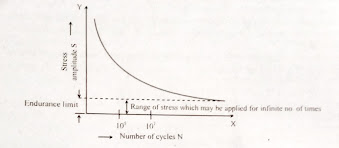
Draw S-N curve for steels and show endurance limit on it.

Image
 S - N curve In S-N curve, 'S' stand for "Stress" arising out of repetitive load and 'N' stands for "Number of cycles to failure". The fatigue strength more appropriately termed the endurance limit is usually determined from a polished specimen subjected to reversed bending. The graph mentioned above is an example of S-N curve. The line is downward-sloping. Where the endurance limit is shown. Endurance limit is the stress level below which a specimen can withstand cycle stress indefinitely without exhibiting fatigue failure. But failure will occur often a diminishing number of cycle as the range increases above this limiting value. The endurance limit for more of steels is found to be roughly half of the ultimate tensile stress.

What is stress concentration? Explain the methods to reduce stress concentration.

Image
  Whenever a machine part suddenly changes its geometrical shape, the simple stress no longer remains the same but increases.This increase in stress due to sudden change in geometrical shape is called stress concentration. Geometric discontinuities cause on object to experience a local increase in the intensity of a stress filed. The stress concentration occur near cracks, sharp corners, holes and changes in the cross sectional area of the object. It should also be noted that tool marks. Porosity in casting etc. may also give rise to stress concentration effect. High local stresses can cause the object to fail more quickly than if it wasn't there.                                      Engineers must design the geometrical shapes of the objects to minimize stress concentrations. In many design situations , it is not possible to altogether avoid the effect of stress concentration, but it can...